GreatWritersFranzKafka

  • Subscribe to our RSS feed.
  • Twitter
  • StumbleUpon
  • Reddit
  • Facebook
  • Digg

Monday, 12 November 2012

Little Red Riding Hood Revisited

Posted on 04:32 by Unknown

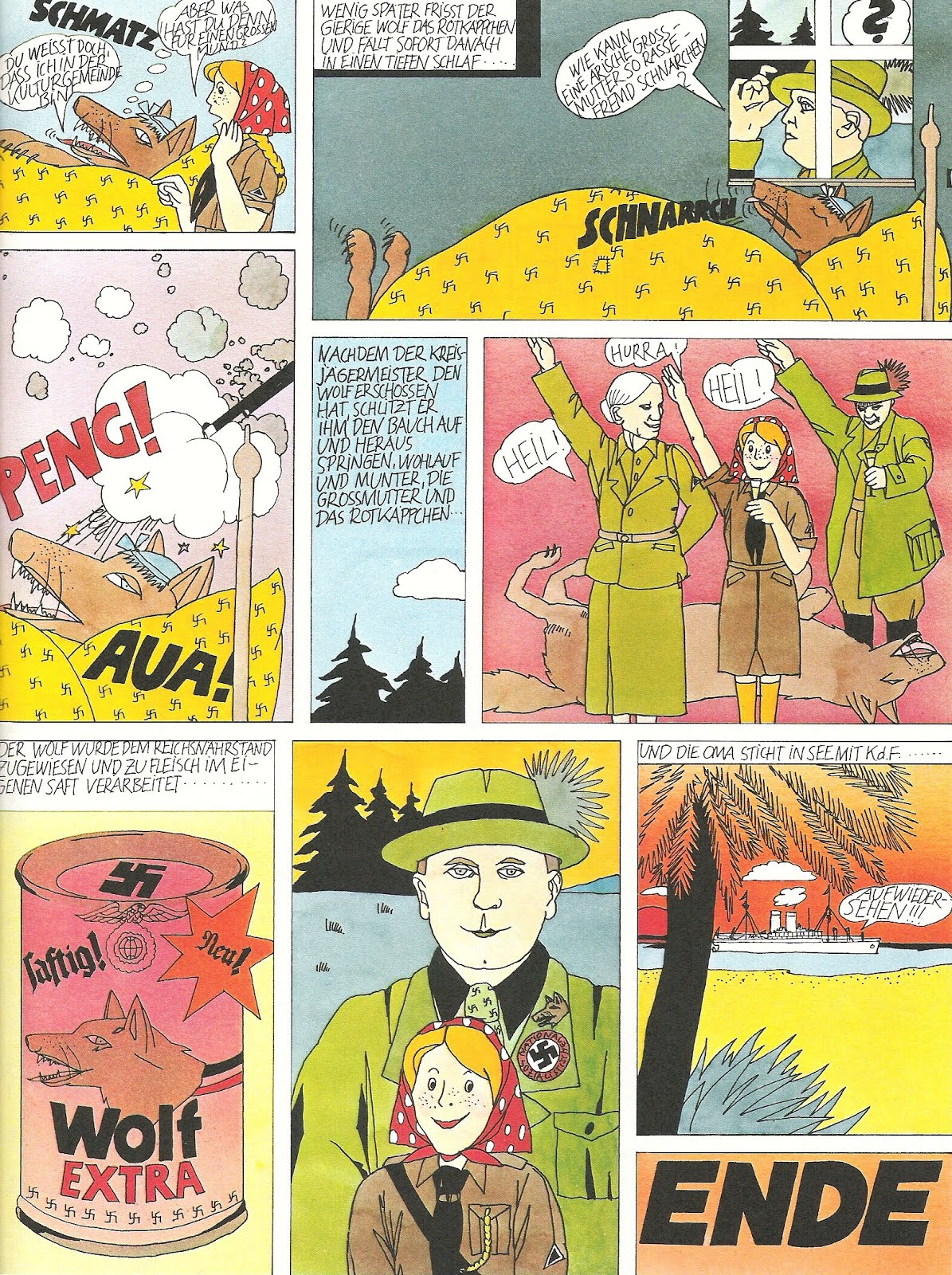
For a very short period in Nazi Germany, in early 1937, censorship was relaxed permitting the print of this version of the fairy tale on the Münchner Netteste Nachrichten´s “Fashingausgabe” (“Carnival Edition”), which was already circulating anonymously for some time as manuscript. The authorities reacted quickly and the edition was eventually confiscated by the Gestapo with the arrest of its publishers. In this version, the hunter says that the grandmother´s snore “did not look very Aryan".
  The wolf is processed into canned soup, the little girl joins the Federal League of German Girls and old grandmother eventually earns her long dreamed  summer holiday in the famous "Kraft durch Freud"`s (German for Strength through Joy) cruise fleet in the Madeira Island, a organization which promoted mass tourism and travel packages either distributed as prize for loyal workers, or also promoting mass holidays at a monumental building complex at the shores of the Baltic Sea, a revolutionary phenomenon since the French workers had won the right for annual paid 30 days Holidays in the middle of the thirties. In another version of the re-fashionable tale by the Propaganda Machine at the same  time, Hitler himself appears, so bizarre as it may sound, as Little Red Riding Hood. For further readings I recommend strongly "Red Riding Hood in the Third Reich: German fairy tale movies between 1933 and 1945" ("Die deutsche Märchenfilmproduktion zwischen 1933 und 1945. Ein Überblick.",Deutsche Kinemathek Museum fuer Film and Fernsehen) 

Monthy Pynthon´s version dialogues with this undercurrent of humor, which always exists for most monolithic a society may be as in the former GDR in the seventies and its infamous Stasi.


Illustrations recreated by Gabrielle Richter:


Original German:

"Es war einmal vor vielen, vielen Jahren in Deutschland ein Wald, den der Arbeitsdienst noch nicht gerodet hatte, und in diesem Wald lebte ein Wolf. An einem schönen Sonntag nun, es war gerade Erntedankfest, da ging ein kleines BDM-Mädel durch den Wald. Es hatte ein rotes Käppchen auf und wollte seine arische Großmutter besuchen, die in einem Mütterheim der NSV untergebracht war. In der Hand trug es ein Körbchen mit einer Pfundspende und einer Flasche Patenwein. Da begegnete ihm der böse Wolf. Er hatte ein ganz braunes Fell, damit niemand gleich von Anbeginn seine rassefremden Absichten merken sollte. Rotkäppchen dachte auch nichts Böses, weil es ja wußte, daß alle Volksschädlinge im Konzentrationslager saßen, und glaubte, einen ganz gewöhnlichen bürgerlichen Hund vor sich zu haben. "Heil, Rotkäppchen!", sagte der Wolf. "Wo gehst du denn hin?" Rotkäppchen antwortete: "Ich gehe zu meiner Oma ins Mütterheim." "So", sagte der Wolf. "Aber dann bring ihr doch ein paar Blumen mit, mit denen das Amt für Schönheit der Holzarbeit den Wald geschmückt hat!" Sogleich machte sich Rotkäppchen daran, ein Erntesträußchen zu pflücken. Der Wolf aber eilte zum Mütterheim, fraß die Großmutter auf, schlüpfte in ihre Kleider, steckte sich das Frauenschaftsabzeichen an und legte sich ins Bett. Da kam auch Rotkäppchen schon zur Tür herein und fragte: "Nun, liebe Oma, wie geht es dir?" Der Wolf versuchte, die volksnahe Stimme der Oma nachzumachen und antwortete: "Gut, mein liebes Kind!" Rotkäppchen fragte: "Warum sprichst du heute so andersartig zu mir?" Der Wolf antwortete: "Die Rednerausbildung am Vormittag hat mich zu sehr beansprucht." - "Aber Oma, was hast du für große Ohren?" - "Damit ich das Geflüster der Meckerer besser hören kann!" - "Was hast du denn für große Augen?" - "Damit ich die Wühlmäuschen besser sehen kann!" - "Was hast du denn für einen großen Mund?" - "Du weißt doch, daß ich in der Kulturgemeinde bin!" Und mit diesen Worten fraß er das arme Rotkäppchen, legte sich ins Bett und schlief in seiner verantwortungslosen Art sofort ein und schnarchte.
 Da ging draußen der Kreisjägermeister vorbei. Er hörte ihn und dachte: Wie kann eine arische Großmutter so rassefremd schnarchen? Und als er nachsah, da fand er den Wolf; und er schoß ihn, obwohl er keinen Jagdschein für Wölfe hatte, auf eigene Verantwortung hin tot. Dann schlitzte er ihm den Bauch auf und fand Großmutter und Kind noch lebend. War das eine Freude! Der Wolf wurde dem Reichsnährstand zugewiesen und zu Fleisch im eigenen Saft verarbeitet. Der Kreisjägermeister durfte an der Uniform einen goldgestickten Wolf tragen, Rotkäppchen wurde zur Unterführerin im BDM befördert, und die Großmutter durfte auf einem funkelnagelneuen KdF-Dampfer eine Erholungsreise nach Madeira machen."

(From: Münchner Netteste Nachrichten - Faschingsausgabe der Münchner Neuesten Nachrichten 1937) 


Storyteller: Once upon a time there was a little house in a dark forest. In this house lived a humble woodcutter and his wife and their pretty daughter, Little Red Riding Hood.And in the middle of this deep, dark forest, there lived a vicious wolf!
One day Little Red Riding Hood sent off to take some things to her old grandmother who lived deep in the forest.
The vicious wolf saw Little Red Riding Hood and thought:
"She looks very good to eat!" "Where are you going my, pretty one?" "Oh, kind sir, to my grandmother's." "Ha, ha, ha, ha!" snirked the wicked wolf and dashed off through the forest to grandmother's house.
"Knock, knock, knock" went the wicked wolf. The door opened wide, but it wasn't grandmother who opened it.
It was Buzz Aldrin, America's #2 spaceman! But this was not Granny's little house at all, but the headquarter of NASA, the American space research agency.
The wicked wolf was shot by security guards.
So all was quiet in the forest again. The humble woodcutter and his wife sold the their story to Der Speigel
for 40 000 DM. NASA agreed to limit the number of nuclear tests in Granny's little house to two on Thursdays and one on Saturdays after tea.
Read More
Posted in | No comments

Sunday, 11 November 2012

The Mechanical God (Introduction) Low Voltage Ontological Currents by Brian W. Aldiss

Posted on 01:18 by Unknown

Robots are just lonely people.

Robots have much to do with technology—particularly technology at play; they have much more to do with humans—particularly humans at bay.

The alien is (generally) to be hated. The robot is (generally) to be pitied. The robot is in many ways a shadow of ourselves, our stolen reflection, a beautiful thing whose attraction is dangerous. Such is the argument I wish to pursue here, to introduce essays designed to consider that gray area where human and machine join and complement each other.

Engineers have always found it easy to build attractive robots. Ugly robots do not exist, unless they are wildly asymmetrical. Yet ugly humans abound. And one of the ugliest objects ever seen is a prototype four-legged truck which walks, designed by General Electric for the army. It has legs in place of wheels. Why should we perceive four-legged trucks as against nature, whereas the substitution of metal for skin in some mysterious way pleases our instincts?

We find it easy to be charmed by beautiful or anthropomorphic things. Most of the robots in fact, fiction, and play have been designed beautiful. They certainly delight children. In the nursery, robots have defeated teddy bears, dolls, golliwogs, and even Action Man in the popularity polls. Their flashing eyes, clutching arms, growling voices, and military march do not fool us. We know they’re lovable. They shine for us.


To date, few people have had to cope with more than one robot at a time. So far at least, the robot appears as an emblem of solitude, a man in an iron mask, a knight in shining armor, an asexual creature who cannot mate, and in any case has no female to mate with.

Robot communities are as rare as cities full of men in iron masks.

The first robot culture in fiction—though some scholar will pop up and tell me that it was not the first—is in Frigyes Karinthy’s Voyage to Faremido. Faremido is a planet populated by beautiful robots. Karinthy’s robots are called solasis, and they are more than just pretty faces.

Now and then it turned to me its gleaming, golden metal head; a bluish light shone upon me from the brilliant eyes; then it started to sing, and now I felt clearly that it was addressing me with these sounds; that in this country the language was made up of music, and that the words consisted of musical phrases. (1)

The solasis manufacture their own kind in factories. They study Earth through their telescopes and consider that human beings are a kind of pathogenic germ, which can destroy the solasis. The hero becomes convinced by their arguments after living with them for some while, and begs the machines to transform him into one of them. But he is too primitive, and instead they return him to Earth.

It is true this is satire, modeled overtly on Jonathan Swift, yet its mood is tender. This is the more remarkable—and so is the sophistication of the robot society—when we recall that it was written during World War I and published in Budapest, Karinthy’s home, in 1917. Karel Capek’s androidlike robots were still some years in the future; automation and cybernetics still dreams. Voyage to Faremido is a brilliantly original story and rejoices in the beauty of robots long before the arrival of the lovely female robot in Fritz Lang’s Metropolis (1926), or the male robot Erik, who features on the cover of Jasia Reichardt’s compilation, Robots: Fact, Fiction, and Prediction (1978). (2) (Erik starred in a Model Engineer exhibition in 1928. He was one of the “real” robots which were popular throughout the thirties.)


Robots have never belonged entirely to science fiction. The first emperor of China, Ch’in Shih Huang Ti, had built for him in 206 B.C. a mechanical orchestra comprising twelve musicians cast in bronze and dressed in silks, who played lutes or guitars and were worked by ropes and human breath. From this elaborate mechanism, to the automata which delighted the eighteenth and nineteenth centuries, to the industrial robots of today, automata have played a considerable role, generally rather petlike, of more considerable importance than their role in fiction.

In our century, the robot graduated from the role of pet or plaything as the possibility of building working robots increased. His influence on art, for instance, has been great. The fathers of pop art in the early fifties, as Richard Hamilton, one of their leaders, has confessed, were hooked on science fiction and science fiction movies, particularly if robots were involved. According to one critic, “the robot seems to have been the patron saint of the movement.” (3) Like the futurists before them, the pop artists were mad on everything shiny and technologically competent. Jim Dine, Jasper Johns, Claes Oldenburg, Roy Lichtenstein, and George Segal, all involved with questions of multiple image and machine rivalry as sibling rivalry, are brothers to science fiction writers.


Eduardo Paolozzi—hardly an orthodox pop artist—has created many robots and figures from unexpected metal parts which represent the metamorphosis of rubbish. His alien technologies become compressed and interiorized in an ideal way, particularly in some of his collages and screen prints, which resemble escalated technological areas such as printed circuitry. Paolozzi himself has said of science fiction, “It might be possible that sensations of a difficult-to-describe nature be expended at the showing of a low-budget horror film.” (4) We all know about those difficult-to-describe sensations; they are what an SF writer deals in—or, more exactly, hopes to be able to deal in. Robots, as strangely neutral nonbeings, lead us to the question of our being and that central puzzle.

Pop art is interested in surfaces and duplication of images and technological fantasy. Andy Warhol does more than sum matters up in an interview he gave toG. R. Swenson:


I think everybody should be a machine.
I think everybody should like everybody.
Is that what pop art is all about?
Yes, it’s liking things.
And liking things is like being a machine?
Yes, because you do the same thing every time.
You do it over and over again.
And you approve of that?
Yes, because it’s all fantasy. (5)

One can almost hear the incredulity in the interviewer’s voice. But the interesting thing is that everyone since Ch’in Shih Huang Ti has been warm and friendly (or, to include Warhol, cool and friendly) toward our metal friends. Only in works of what we loosely call science fiction has the robot become foe to man. Even in the work that gave robots their name, R.U.R., they are already up in arms against us.


Why this should be is difficult to see. Robots are generally solitary since they represent outsiders or antiheroes in human society. In the mass, they perhaps represent something different—shorthand for the Wehrmacht, for example. Technocratic science fiction writers, like the early Asimov, long for law and order—which in our age means technological order. But order is not possible in disorderly human affairs, or not at our present youthful evolutionary stage; nor will it be until we are reduced to a robotlike state of obedience. Robots, being amenable to laws and orders, are amenable to order. They make ideal citizens—but only of a dead culture.


This point is dramatized in one of the most interesting of all robot novels, Jack Williamson’s Humanoids (1949). The dark and beautiful little robots suggesting in form animae, seek by kindly means to reduce man to a happy and secure state of being. The hero is a man who rebels, recognizing such domesticating utopianism as death to the spirit.

The ideas robots conform to are, of course, humanity’s ideas. But man comprises emotion as well as intellect. Man, being whole, is always in conflict with his own ideas. Robots are only half human. In consequence, they are able to conform to man’s intellectual ideas against which his spirit constantly rebels.


Robots are lonely people because they exemplify current isolations inseparable from our industrial society. They are literally encased in technology. Of course, the interpretation of the role of the robot must vary according to the individual author, but, if we regard them as flagships of a future technology, then we are predicting that mankind will be imprisoned in that technology, because we do not respond to robots as aliens; because the way people in general respond to robots is to treat them in a welcoming fashion, as people. The beautiful Barbarella accepts Diktor as her lover and praises him (though the poor robot’s response is to say apologetically that there is “something a bit mechanical about my movements”). (6)

If this is what we are to become—beings without emotional tone, with merely automatic responses to given situations—then robots represent in symbolic form the next stage of human evolution. In which case, we should take heed of the warning and accept a measure of chaos in preference to a rule of logic. Such is the message we receive from the novels of Philip K. Dick, one of the best robotic-writers, because he generally uses his robots as buffers between the living and nonliving. In Dick’s characters, the ontological current, the current of being, fluctuates under pressure of modern society, whether here or on Mars; his robots are paradigms of people isolated through illness, with low-voltage ontological currents.


Sometimes robots are aware of what they lack and, like the Tin Man, go in search of it. Such is the case of Jasperodus, the robot whose Bildungsroman is Barrington J. Bayley’s Soul of the Robot (1974). (7) Jasperodus works his way towards an understanding of consciousness.

The best-known example of robots as forming the next stage in human evolution appears in Clifford Simak’s City (book form 1952). (8) The humans, the Websters, pass on most of their responsibilities to Jenkins, the robot, and robots are then left to run affairs. As a result, the humans disappear from Earth and even lose human form. A dramatic embodiment indeed of the division between will and psyche, or intellect and emotion, or however one cares to phrase a dichotomy of which all are aware. Interestingly, Jenkins begins his existence as a sort of butler or gentleman’s gentleman, the breed of human which most closely models its behavior on robotic responses.

As long as we understand this symbolic function of robots, all is spiritually well. As soon as we cannot understand it, or as soon as we start admiring robots for being robotic, we are in the Warhol position of rejecting our own feelings, and hence of rejecting reality. In my robot novel Eighty-Minute Hour (1974), ruinous human affairs are taken over after a third world war by a massive computer complex whose robotic projections rule the sociopolitical system; this is acceptable only because, as one of the characters says, the computer complex “represents a genuine human desire to repress its humanity.” (9)

Robots in their pet function are valid. So are robots in their function as analogs of our dehumanized selves. There is a middle ground where robots may achieve dramatic effect in stories but must inevitably remain without extraliterary meaning. An instance is the robot story where the machines are so likely to kill humans that laws are built in to stop them from doing so—laws which they may then circumvent, or appear to circumvent. As a plot idea this is exciting, but its significance is doubtful; we must suffer from paranoia before the requisite frisson of fear persuades us that these animated hunks of technology can in any way possess sinister motives (that is, think and feel as humans do).

Another instance where even the literary effect is questionable is when robots are portrayed as beings of metal otherwise indistinguishable from human. Female and marriageable robots enter under this heading. To take such sentimentality seriously is neither literature nor science. A robot aspiring to human emotion, or deceiving humans into thinking that it feels emotions, is a subject for comedy or for satire, as Robert Sheckley realized long ago.


One must make it clear that this sweeping statement does not include androids—robots which look very like or are indistinguishable from humans. The human trait which fears things like humans that are inhuman is an ancient one, so ancient that we might even believe there were vampires in Babylon. Nothing is more terrifying than a corpse that moves. Androids are corpses that move—dead to us as far as emotions go, without ontological current. The Yul Brynner android in Michael Crichton’s film Westworld goes on moving when it should be destroyed—a fearsome example of what androids may get up to. Silicon chips they may have; love and hate they do not.

What never fails to alarm us in science fiction is robots and androids that act as if they love or hate, whereas in reality they are just obeying a program. One of the most telling of all robot stories is Walter Miller’s “I Made You” (1954), in which a man lies dying in a cave on the moon, trapped there by a mobile autocyber fire-control unit whose receptors have been shot away so that it cannot tell friend from foe. The man programmed the unit. Flence his dying plea, “I’m human, 1 made you. . . .” (10) But nothing can be done. The war machine is immune to argument. It has no mercy. It has no intelligence, no emotions. Damaged, it is implacable simply because it is a stupid obedient robot. It certainly alarms us.

The essays in this volume concentrate on the technological and social implications of robots and other machines in science fiction. Most readers or cinemagoers read robots in a more visceral sense, I believe. What sort of human being neither loves nor hates, but instead obeys a program? Answer: the psychotic human being. Robots very effectively symbolize psychotics. And of course the sickness brings solitude. Illness isolates. In the words of John Donne, “As sickness is the greatest misery, so the greatest misery of sickness is solitude.” (11) Robots are lonely people, and always low on ontological current.

With populations growing in high-density urban clusters last century and this, isolation has paradoxically grown apace. Mental illness has also increased. By corollary, mental illness is increasingly studied, and we now understand how humans suffer from many robotlike disorders—compulsive behavior and all sorts of incorrect programming. Not only human psychology but human physiology too has been submitted to new tests, particularly in relation to speed (space travel being the prime case); human beings have been required as never before to function as extensions of the machine.


There are virus diseases which turn people into robotlike creatures, one of the most remarkable being the sleeping sickness, encephalitis lethargica. A wave of this virus swept the world for about a decade, from the time of World War I through the twenties, claiming some five million lives. A few patients, preserved in American sanitariums, lived out their lives in strange and strangely various states of living death, until, in 1969, it was discovered that the drug L-Dopa had a dramatic effect on them. Some were able to arouse themselves into normal states of being and recount what they had experienced. The classic account of these experiences is Oliver W. Sachs’s Awakenings (1973). If robots could communicate, they would speak as do Sachs’s patients:

I ceased to have any moods. I ceased to care about anything. Nothing moved me— not even the death of my parents. I forgot what it felt like to be happy or unhappy. Was it good or bad? It was neither. It was nothing.

You see, my space, our space, is nothing like your space: our space gets bigger and smaller, it bounces back on itself, and it loops itself round until it runs into itself. (12)


Preceding an attack of the illness, one patient dreamed a fearful premonitory dream, in which she was imprisoned in an inaccessible castle, but the castle took the form and shape of her herself. She also dreamed that she had become a living, sentient statue of stone. She dreamed of a death that was different from death.

Recovery was sometimes no less dramatic. A patient jumped up in the twinkling of an eye, after many years of being totally motionless. Her period of being deactivated had no subjective duration. In the words of Sachs, “it was as if the ontological current, the current of being, could be suddenly ‘switched off and as suddenly ‘switched on,’ with no loss of action patterns in between, nor any need to relearn them subsequently—and this because for her no time had elapsed.

Lonely and sick people tell us what the robot state is like. It is a life that is different from life. Few passages quite as vivid as these reports emerge from science fiction literature, although there have been phases of popularity for stories in which the chief character, even the “I” persona, has stood revealed as a robot. Philip Dick’s title character in “Imposter” (1953) turns out to be a perambulating A-bomb, to his own surprise as much as humanity’s. The writer of Chan Davis’s “Letter to Ellen” (1947) has trouble proposing to the eponymous lady, since he must break it to her in the same breath that he is a - - (14)

There may be symbolism here, but there is little examination of the inwardness or lack of inwardness in robots. Science fiction is traditionally an outward-directed literature. 1 believe it stands on the threshold of another great adventurous phase, when it will exploit the inwardness of the themes that have been waiting on its doorstep all along.

Robotry would be as good a place as any at which to start.


NOTES

1. Frigyes Karinthy, Voyage to Faremido (1917; rpt. London: New English Library, 1978), p. 34.
2. Jasia Reichardt, ed., Robots: Facts, Fiction, and Prediction (London: Thames and Hudson, 1978).
3. Rosemary Dinnage, Times Literary Supplement, 7 March 1980, p. 264.
4. Diane Kirkpatrick, Eduardo Paolozzi (Greenwich, CT: New York Graphic Society, 1969).
5. John Russell and Suzi Gablik, Pop Art Redefined (London: Thames and Hudson, 1969), p. 116.
6. Jean-Claude Forest, Barbarella, orig. publ. Grove Press, 1966, from the frame as rpt. in The Visual Encyclopedia of Science Fiction, Brian Ash, ed. (New York: Harmony Books, 1977), p. 216.
7. Barrington J. Bayley, The Soul of the Robot, rev. edn. (London: Allison & Busby, 1976).
8. Clifford Simak, City (New York: Gnome Press, 1952).
9. Brian Aldiss, Eighty-Minute Hour (London: Jonathan Cape, 1974), p. 14.
10. Walter Miller, “I Made You,” Astounding, March 1954, p. 55.
11. John Donne, as quoted in Oliver W. Sachs, Awakenings (1978; rpt. London: Penguin, 1976).
12. Oliver W. Sachs, Awakenings, pp. 96-97.
13. Ibid., p. 129 n.
14. Chan Davis, “Letter to Ellen,” Astounding, June 1947.

In: The Mechanical God: Machines in Science Fiction. Machines in Science Fiction. Edited by Thomas P. Dunn and Richard D. Erlich (Editor). London (1982), pp. 3-9.
Read More
Posted in | No comments

Thursday, 8 November 2012

The Fragments of the Mirror: Alfred Hitchcock`s "Vertigo" (1958) by Alain Silver and James Ursini

Posted on 23:42 by Unknown


Alfred Hitchcocks`s relationship to the noir style is even more dificult than Woolrich´s "Shadow of a Doubt", "Notorious", "Strangers on a Train", even "The Wrong Man", a title which could describe a whole subset of noir films, all have elements which qualify them as noir but none are core examples of the noir movement. In terms of narrative, The "Paradine Case", "Psycho", even "Stage Fright" could be noir; but are they? Doubles and mirror images are stylistic keys to "Vertigo" (1958). The obsessed detective hero even refers to the dreams of his client's wife as "fragments of a mirror." Yet "Vertigo" is so reliant on the point of view of this character for its dramatic impact, that it lacks a sense of a noir underworld, of an undercurrent of fatality and menace that, as Al Roberts noted, "can put the finger on you or me for no reason at all." 

Madeleine Elster (?)


In the process of transforming Judy (Kim Novak) into his lost love Madeleine, Scottie Ferguson (James Stewart) must bring her into his perception of reality. In this mirror shot, he looks at and through Judy trying to see the woman he wants within. The mirrored panels behind her do not reveal an alternate or more appealing perspective. It is because he is cognizant of the dichotomy between real and imagined that Ferguson is troubled. The image he seeks is beyond both the literal woman proximate to him and her reflection beyond. There is no added stylistic comment from lighting, angle, etc. because Ferguson's point of view is the overriding factor.

Or Judy Barton (?)


In: The Noir Style, (1999) by Alain Silver & James Ursini.


Read More
Posted in | No comments

Wednesday, 7 November 2012

Possible People Thoughts on the Literary and Cultural History of the Android by Peter Gendolla

Posted on 01:02 by Unknown


It’s not pleasant to discover you were invented. (Jack Slater alias Arnold Schwarzenegger alias Arnie Schwarzenegger in Last Action Hero)

Technical inventions do not simply make work easier, they also allow their constructor to gain an understanding of himself, of how he functions. This human impulse to explore internal connections by projecting external mechanisms onto them is nowhere more evident than in the automaton (Greek αὐτό-ματον, “that which acts of itself"). Be it by the ancient Chinese, by the contemporary Japanese and Koreans in their factories, or by the chip- smiths in Munich or Silicon Valley, automatons have always been constructed to act as useful helpers, slaves, no less - the word robot originally signified laborer - but also as "useless playthings.” Automatons have lifted weights, ground grain, and today are in the process of undoing, after a fashion, the Babylonian linguistic confusion as computer translation programs. Moreover, they have been disguised as nightingales or ducks, have entertained royalty at the Baroque courts in complete automaton theatrical troupes, and these days constitute one of the industrial branches with the largest turnover, as Nintendo or Sega systems, adventure games in cyberspace. In this very tradition, in these countless variations of the mechanical man, a new self-image of the individual and his social body has always been playfully documented, as if in passing. In his book “L’Homme machine" (Man a Machine) of 1747, the notorious 18th century philosopher Julien Offray de La Mettrie made perhaps the most disputed proposal for a new image of man disconnected from traditional metaphysical foundations, an image which, in its basic elements, finds its continuation today in proposals by biologists to improve the human genome. So it's worth taking a look.

La Mettrie

After a careful analysis of the contemporary and historical reception of La Mettrie’s major work "L’Homme machine,” its modes of argumentation, and its contexts, the cultural historian Alex Sutter comes to the following conclusion: “The implications of the image of the machine in 'L’Homme machine' can be summarized under the following headings: Polemical content: the physicalization of the soul as opposed to spiritualist rationalism. Methodological content: open-minded empiricism with regard to the body- soul problem. Conceptual content: organized matter as a comprehensive basis for the unity of body and soul (...). Metaphysical content: outline of a 'materialistic vitalism’. Communicative content: disappointment of the spectacular expectations engendered by a mechanistic anthropology." (1)

To regard La Mettrie as a mere "mechanizer” of man, to situate his "manifesto" (Sutter) among paradigms from the history of biology (vitalism/mechanism), or to emphasize the vitalism, would not do justice, therefore, to the "sprightly many-sidedness" of the image of the machine which he stood for. This essay agrees with Sutter, though at the same time training a keen eye on the evidence La Mettrie presents for the way man functions as a machine. He writes: Opium "makes a man happy in a state which would seemingly be the tomb of feeling, as it is the image of death. How sweet is this lethargy! The soul would long never to emerge from it. For the soul has been a prey to the most intense sorrow, but now feels only the joy of suffering past, and of sweetest peace." (2)

Sutter sees this as evidence of La Mettrie’s ignorance of the empiricist prohibition of introspection, as a result of which he relegates the machine model "to the status of a metaphor.” (3) It would thus function rhetorically as a "methodological guideline for a scientific objectification of man’s insides," that is to say, as an inspiration, a guiding metaphor for the most varied of applications, be that in the field of medicine, technology, or aesthetics. The metaphor constitutes the framework within which the body can be cut open, the organs duplicated, and the soul analyzed. Attention should be focused, however, on La Mettrie's reasoning, that is, on what causes or triggers the use of artificial or technical aids - such as opium - in a body that thus automatically seems to be a technical object: nothing but pain, terror, shock. The dilemma facing every man- machine comparison since Descartes as to how the res cogitans and res extensa might hold or work together is solved by La Mettrie - as by many before and after him, from Descartes to radical constructivism - by postulating a self in the αὐτό-ματον, a "principle of movement" inherent in organic matter, as opposed to "non-organically structured matter." That "suffices for guessing the riddle of substances and of man.’’ (4) Yet in no way is the problem solved by La Mettrie either, because the self of this autopoiesis remains a vacuum or tautology, an observation endowed with a name. What the “torch of experience” (5) does illuminate more and more clearly, however, is not a regular system of mechanics, not even one that might be formulated in algorithms, but rather, that which triggers it, namely excitation, terror, and pain.

“Is the circulation too quick? the soul cannot sleep. Is the soul too much excited? the blood cannot be quieted: it gallops through the veins with an audible murmur: Such are the two opposite causes of insomnia. A single fright in the midst of our dreams makes the heart beat at double speed and snatches us from needed and delicious repose, as a real grief or an urgent need would do." (6)

Before writing his polemical treatise, La Mettrie was forced to earn his living for a while as a doctor in a military hospital. It was there that he had the "most decisive experiences" with which he hoped to demonstrate the mechanics of organic bodies, namely, the experience of injuries to an organic whole, the blatant opposite of an undisturbed peace and tranquil, egalitarian communication between body parts. Yet mechanical-organic integrity/unity is insisted upon almost frenetically with such 'terrifying' examples, as if the life principle had to be maintained literally beyond death, despite the interventions, or better still, attacks on life: "1. The flesh of all animals palpitates after death. (...) 2. Muscles separated from the body contract when they are stimulated. (...) 5. A frog’s heart moves (...) after it has been removed from the body, especially when exposed to the sun (...). 6. (Sir Francis) Bacon (...) cites the case of a man convicted of treason, who was opened alive, and whose heart thrown into hot water leaped several times, each time less high, to the perpendicular height of two feet. 8. (I)n hot water, (...) the movement of the detached parts increases. 9. A drunken soldier cut off with one stroke of his sabre an Indian rooster’s head. The animal remained standing, then walked, and ran (...). 10. Polyps do more than move after they have been cut in pieces. In a week they regenerate to form as many animals as there are pieces.” (7)

Sutter argues that unlike mechanistic theories, La Mettrie ignored contemporary rules of discourse derived from the model of the machine or clock, that is to say, "clarity (or physical explicability),” “mathematical conformity,” "integration of the whole into a single large causal connection with a practical structure, etc.” (8) are simply not to be found in his writings. What is to be found, however, is the urgent demand for the same. The work makes every effort to claim the existence of a whole, a connection, an uninterrupted communication between every living thing. The 'man- machine' - "clearly an enlightened machine,” "a large watch constructed with such skill and ingenuity” (9) - represents the most noble expression, the most complex material manifestation of a virtual construct. Confronted with the observation or experience of its destruction, life is reconstructed with the aid of the machine metaphor, and becomes a phantom: "Let us, therefore, draw the daring conclusion that man is a machine, and that there is only one substance in the whole world and this of course is variously modified." (10)

The 18th century is indeed the age of dissection, in all realms, not just in anatomy (more precise and effective surgery in the medical field), but even more so in the economic sphere, in production, from handicraft to the manufactories to the first factories of the industrial era. The painful awareness of this division of labor or differentiation of social functions resounds throughout the Ouerelle des anciens et des modernes like a lament about a ruptured late or modern age, an age at odds with itself, as opposed to an integral early or ancient Arcadian age. It also turns up in the interchanges between Goethe and Schiller. For Goethe, the resultant utopia of vital wholeness was no doubt Italy: "Et ego in...”. In the end, out of the splintering of the “moderns,” Schiller constructed the "aesthetic” state, perfect in itself. In his letters "Über die ästhetische Erziehung" (On the Aesthetic Education of Man) he claimed that only art was capable of bridging the gaps created by modernism, of restoring man's wholeness. As early as 1791, in his much quoted critique of Gottfried August Bürger’s poems, Schiller writes: "Given the isolation and the disjointed effectiveness of our spiritual powers, made necessary by the broadened circles of knowledge and the segregation of professional occupations, it is poetry alone that gathers together once again the separated powers of the soul, that preoccupies in harmonious accord head and heart, discernment and wit, reason and imagination, that restores, as it were, the whole man in us.” (11)

Vaucanson

Jacques de Vaucanson is someone who vigorously promoted the “isolation" of the spiritual powers and the expansion of the circles of knowledge, plus the subsequent "segregation of professional occupations," that is to say, someone who warmly welcomed and ingeniously furthered the technologies of the division of labor. Like no others before them, his automata, the "Flute Player" (1738), the "Tambourine Player” and the "Duck” (both 1739), stimulated the mechanical fantasies of the 18th century and beyond - from La Mettrie to Reimarus and Goethe. (12) What is less well known, though, is just how closely connected work and play were for Vaucanson, the interplay of skillfulness and ingenuity, which were concentrated in his main obsession: to isolate or separate the controls or steering force from the movement of the body/machine parts, to transfer these to their own steering/control sector or organs, and to divide them up into the process sections controls/transmission/operation, enclosed inflexible hollow bodies - a technique we today would call module or black box systems.

Vaucanson was appointed director of silk manufacture in Lyon in 1740. Here, long before Jacquard, who is credited with inventing the perforated card control system in 1805, Vaucanson developed automatic controls for looms. (13) To do this, he transferred the cam controls used in mechanical toys and musical boxes to the work machines, reversing the principle and thus developing perforated disc controls.

In Schiller’s sense, one could regard this expansion of the circles of knowledge and the isolation or segregation - later McLuhan would call this extension - of the effectiveness of spiritual powers as also being responsible for the technical inventio. Social differentiations go hand in hand with greater demands on the individual spiritual powers, resulting in an overtaxing of those powers. On the one hand, this very pressure on the individual capacities leads to the invention of technical aids, the functional modes or theories of which are formulated in the anthropologies of technology put forward by Lewis Mumford, Arnold Gehlen, Marshall McLuhan or Günther Anders, and the history of which is nothing more than the history of automation - from Vaucanson to the current programs of so-called Artificial Intelligence, irrespective of whether they control washing machines, prostheses, or whole factories. (14) On the other hand, and in interaction with this, aesthetic perception, the perception of perception, is worn down: what happens to sensations, how are senses expanded, filtered, intensified, shaped or tinted, (15) when the body that thus perceives itself is extended or restructured by technical artifacts? The fantasies about machine-men entertained by writers from Jean Paul to E .T. A. Hoffmann to the science fiction of our day can be seen as a direct reaction to this. Indirectly, though just as clearly or strikingly, the various 18th century literatures, cults or cultures of Empfindsamkeit (Sensitivity) can be regarded as in a way articulating the internal reactions to the external aids. It is no coincidence that as early as 1777 Goethe, who had contributed consider-ably to this culture with his "Leiden des jungen Werther" (Sorrows of Young Werther) of 1774, distanced himself in his "Triumph der Empfindsamkeit" (Triumph of Sensitivity) from such inwardness-, from that “theatrical whim” (Goethe) about love, i.e., "the electricity offender hearts," for an artificial woman, surely the direct model for Hoffmann’s famous doll Olimpia in the story “Der Sandmann” (The Sandman) of 1815. Another direct reaction to this can be found in the so-called literature of horror, the terrifying visions of the Gothic novel, an aestheticization of the experience of the individual and social division of labor, from Wilhelm Heinrich Wackenroder's "Märchen von einem nackten Heiligen” (Tale of a Naked Saint) to Mary Woll- stonecraft Shelley's "Frankenstein, or The Modern Prometheus" - still one of the most frequently filmed stories in cinema history-to M.G. Lewis'"Monk" to Hoffmann's “Elixieren des Teufels" (The Devil’s Elixir): What else do these literary works articulate but the sudden terror in the face of amputations, the destruction of physical wholeness, of the possibility of undivided sensations?

Interim Thoughts

La Mettrie's "L'Homme machine" declares man to be a “very enlightened machine”; man is the inspired, the enlightened machine, as opposed to all other machines, the animal-plant-heaven-machines. This recourse taken by the man of the Enlightenment to his own body, this application of rationalism’s main mechanical metaphors to the organic, was encouraged by an 18th century preoccupation that is still vexing today, the emphatic fascination with this watch, i.e., the human body, "constructed with such skill and ingenuity” that, astonishingly, it winds itself up, or stops other clocks, apparently with just as much passion. What is it that draws our attention to our own material composition, what makes the doctor or philosopher claim that the light of reason is both the principle differentiating us from the non-human machines as well as the principle of every living cohesion in any being whatsoever - thereby embroiling him in the real problem of the consciousness debate: Does consciousness exist to greater or lesser degrees? (16) Inspired by La Mettrie’s text, one could formulate a thesis, which though impossible to prove here, might, if padded out with some material, be a useful basis for some further thoughts on already existing or possibly imminent substitutes for man: mechanizations of the body, from the restructuring of the individual body with the help of prostheses to its integration into large - for example military - machine systems, go hand in hand with the amputation of the respective organs and their functions. These in turn produce phantom pains, (17) sensations in no longer existing organs. Art, literature and their diverse media, among other things, come to terms in a particular way, i.e. aesthetically, with this manifold process of substitution or transference.

One consequence of this claim would be that civilizatory, disciplinary, and industrial processes are always reflected in the history of the arts, not directly or simply, however, but rather in pain, that is to say, in the highly varied forms in which phantom pains are processed, among other things, in a historically very diverse aesthetic production and in ever new phantomatic objects articulated in ever new media. Such a thesis inspired by La Mettrie can be pursued in three different discourses: Bellmer’s surrealistic discourse, Freud's psychoanalytical discourse, and McLuhan’s media-theoretical discourse. In the thirties, Hans Bellmer conceived a very peculiar counterpart in the history of artificial man by varying and transforming what he called the “doll." He accompanied his construction of the doll with extensive notes, commentaries, and interpretations. He understood “the various expressive categories: physical pose, movement (...), tone, word, graphics, design of objects (...) as born of one and the same mechanism,” in keeping with the model of the “reflexes provoked by a toothache,” a technique of pain mastery, the re-routing and thus control of an original sensation of pain, a kind of cramped hand. The "cramped hand is an artificial excitation center, a 'virtual tooth’ that diverts the stream of blood and nerves from the real center of the pain, directing it to itself in order to cancel it out." In Bellmer’s view, all aesthetic production comes about as a reaction to a too intense impression, a pain, a disruption of perception and of inner homeostasis. The fantasies that then ensue create their own "excitation centers," self-made phantom pains. He understands their various material manifestations - for example, his "doll’’- as "a consequence of liberating transferals that lead from the suffering to its image. The expression, and what it contains in the way of pleasure, is a pain that has been displaced, a liberation.” (18)

Accordingly, art is the continuation of this liberation in game form, a complex, surprising game played by the organs, parts, and elements now liberated from the original pain, from the whole body - a sign game played by the virtual body parts. Bellmer calls this anagrammatism, art’s body language. It is obvious that his idea goes back to Freud; he entitled his thoughts on this matter: "Small Anatomy of the Physical Unconscious or The Anatomy of the Image." What he was attempting, if you will, was nothing less than to continue to reformulate the pleasure principle, or the functioning of the psychic apparatus, which Freud undertook in his study "Beyond the Pleasure Principle.”

The persistent dreams and fantasies of traumatic events related in analytical practice by war invalids or train accident victims - the loss of an arm or leg - cannot really be understood with the help of the wish fulfillment model put forward in the "Interpretation of Dreams.” Freud structures the apparatus in a more complex way. According to him, the dream/trauma repeats the experience that has come over the subject suddenly or violently from outside - "the main thrust of the cause (seems) to lie in the moment of surprise, the shock” (19) - and destroys the subject’s psycho- physiological integrity, but the dream repeats it as self- inflicted injury, though staged by the dreamer himself. In this way, physical wholeness is reconstructed phantasmagorically.

The third continuation of the thesis comes from the father of current media theories, Marshall McLuhan, whose work is still very much discussed. If his concept of all technology, from the wheel to the processor, as “extensions of men" were to adhere to a simple logic of extension and intensification - "It is a persistent theme of this book that all technologies are extensions of our physical and nervous systems to increase power and speed" (20) - we could safely leave it to the optimists or pessimists of the digital age. In his  "Understanding Media” McLuhan first formulates the effects of such extensions on the psyche and on society, the main focus of his investigation. “Any extension, whether of skin, hand, or foot, affects the whole psychic and social complex." (21) He then expands on this concept. With reference to the kind of medical research that looks upon every extension of the person as “auto-amputation," as a means of maintaining inner balance, he construes technical systems as results of disruptions. "In the physical stress of superstimulation of various kinds, the central nervous system acts to protect itself by a strategy of amputation or isolation of the offending organ, sense, or function. (...) Physiologically, the central nervous system, that electric network that coordinates the various media of our senses, plays the chief role. Whatever threatens its function must be contained, localized, or cut off, even to the total removal of the offending organ." (22)


So art (Bellmer’s) “takes pain in hand," the dream (Freud’s) enables the Ego to reconstruct itself, the external media (McLuhan's) rescue the internal media from super-stimulation and contain the pain. If one understands pain as nothing more than the signal for the severance of representations in the neuronal system from their matter, from cells to organs, and as the destruction of the close cohesion between signified and signifier in the individual body, then there are in fact two possible consecutive effects. The first is that the signal-sign complex - the phantom pain in the sensitive virtual organ - becomes independent. The second is its extension, the placing of the organ outside the body, liberation from the phantom pain by a kind of manifestation of the phantom. The construction of aesthetic objects or technical systems - the two cannot be separated here - goes hand in hand with the anesthetization of the corresponding individual organs. By being transferred to the outside, the functions of the organs order, extend, and intensify the capacities of the individual, and the species, both to perceive and to act.

Even if much in McLuhan is over-hasty analogy - “With the arrival of electric technology, man extended, or set outside himself, a live model of the central nervous system itself’ (23) -, even if Freudian speculation about the psychic apparatus as a protective system against stimulation has little more to say about aesthetic expression than the "repetition compulsion," and even if Bellmer’s virtual and artistic object short-circuits a bit too directly, all three proposals nevertheless attempt to explain very different modes of expression - art, dream/trauma, (media) technology - by means of a virtual, not immediately visible, but very effective object, as a processing of phantom pains concentrated in this object, as a thus regulated interplay between inside and outside. (24) These attempts are to be continued here, and technical constructions and aesthetic perceptions are to be seen in certain respects as parallel phenomena.

"Miracles of Mechanics”: Poppe and Kleist

In 1824 Johann Heinrich Moritz von Poppe gave the title “Wunder der Mechanik" (Miracles of Mechanics) to his description of famous contemporary automatons. He was fascinated not only by the figures that Vaucanson, Kempe- len, Jaquet-Droz, Maillardet, and others had created, but in particular by those of the Tendlers, father and son, whose "Mechanisches-Kunst-Theater" (mechanical art theater) can still be viewed today in Eisenerz in the Steiermark in Austria. It contains, among other things, acrobats that initially hang limp, "like all puppets." "Arms and legs flag like rags, with not the least hint of power in them. As soon as they are placed on the rope, however, they seem to come alive; they swing over and back with great verve, holding on now with two, now with one hand, and hurling themselves around it.” (25)

Poppe’s description immediately calls to mind Heinrich von Kleist’s famous essay "Über das Marionettentheater" (On a Theatre of Marionettes) published in the "Berliner Abendblätter” in 1810. There, too, as with the Tendier pup-pets, one had to do with “appearance”: with Poppe, the appearance of life and power, with Kleist - metaphysically charged - of the lost unity of body and soul, to be found in what is non-human rather than in the "affected" attempts of the human species. Kleist sees this “last element of human influence,” which constantly separates man from himself and sentences him to the helpless observation of his clumsy physical mechanics, overcome in two figures (leaving aside God for a moment as the conceptual figure of all perfection): the bear, an animal that masters its movements instinctively; and the puppet. The center that man has lost persists in these two as an empty yet decisive, i.e., guiding point, a "soul”: "in the center of gravity of the movement” where all forces are brought into balance. Here, too, the thought that governs the conclusion of the essay is the disruption of homeostasis, that graceful interplay between the body’s limbs.

Such natural and therefore quite improbable vivacity is the ideal striven for by the automaton builders. They imitate physical movements or internal processes that are even unusual for man, including the "digestion" of Vaucanson's duck, which ate grain and “after a while excreted a matter similar to duck droppings,” as Poppe remarks with amazement.

In 1760 Friedrich von Knaus presented his "miraculous writing machine" to the public. "The desired text is transferred onto a horizontally positioned cylinder by means of tiny pins. These pins strike keys which move the curved disks of the desired letters by means of a lever.” (26) This technology was developed to temporary perfection in the androids produced by the Jaquet-Droz family and their mechanic Jean-Frédéric Leschot: the "Draftsman,” the “Musician,” and the "Author." (27) The latter was able to combine up to forty characters so as to produce any desired text. The free programming of the automatons thus achieved reveals the cultural orientation and social models of the respective historical periods all the more clearly. If the "Author" writes "Long live the city of Albrecht Dürer” during a presentation in Nuremberg in 1800, and if the "Draftsman” portrays mainly such high-ranking personalities as Louis XV, it is evident that this representation of feudal power has today given way to a catchy salute of welcome in the advertising world. While the clockwork automatons in the early modern era were modeled on the myths of the gods or the history of Christian salvation, and in the 18th century served to represent the power of the sovereign and at the same time the universal craftsmanship of the middle-class citizen, this technical skill becomes the real object of the man-machine constructions in the 19th and finally the 20th century: to reproduce the whole complex apparatus called man, albeit free of pain and defects, in a state of equilibrium. Engineers and artists, scientists and writers - significantly enough, mainly men - now work uninterruptedly on this project of the species, as if they somehow wanted to catch up with women’s natural productivity and finally overtake it some day, with beings that are naturally more faultless than those to date, thereby eliminating the difference between the sexes. (28) However, these constructions initially differed from the "full-bodied automatons,” which now tend to drift into the toy production sector: series productions of talking dolls or quick little fighting robots for under the Christmas tree. In the wake of the inventions of Reis, Bell, Edison, Marconi, and many others toward the end of the 19th century, the individual senses, their perceptions and forms of articulation, are reproduced, specialized or intensified in technical systems; speech and hearing, projection and vision are transformed, and the system of the technical media is further developed. Society is not just trying to maintain itself at a new level or to expand its productivity through these projections and extensions. It is moreover attempting to redefine itself, from the tiniest element to the largest system, from the individual to the state itself. By thus effectively transforming the individual senses into technical media, however, the two disintegrate, both individual and state. The technical reproduction, storage, and transport of voice and ear, eye, nose, and skin, divides the individual up into a field of sensory exchange processes. When national institutions are networked and coupled with global information processes, vital economic, political, and social decisions are transferred from the traditional legislative and executive "bodies” to dynamic, re-coupled media processes which are no longer localizable in space or time. In order to be somehow able to grasp this disintegration and reformation, which run counter to a traditional understanding of decision-making processes, and get an impression of the new bodies and their new communities, there are probably only two figures which in equal measure awaken both technical euphoria and culture-critical anxiety in the late 20th century: the android, robot, cyborg, or what¬ever the new individual is called, and his state supervisor, Big Brother, the intelligence service, the CIA, the Securitate, or the Internet, the greatest conspiracy medium of all time.

In the early 19th century, inspired by Freiherr von Kempelen’s essay “Über den Mechanismus der menschlichen Stimme” (On the Mechanics of the Human Voice), Joseph Faber built his famous talking machine “Euphonia,” which imitated human speech better than all prior attempts - even Kempelen himself had once built a talking machine. It could well be the model, utilized by the cultural critics, for the many artificial women that populate literature, at the latest since E.T.A. Hoffmann. Faber’s talking woman did not bring him anything like the luck, fame, and money that, for example, Kempelen’s “Chess Player" had brought its owner, Maelzel, who even had it challenge Napoleon to a game of chess. (29) Faber destroyed his machine and committed suicide, a fate prefigured in Hoffmann’s story about the "Sandman” and repeated in Villiers de L’Isle Adam's "L’Eve future” (1886), and in 20th century science fiction literature, Lawrence Durrell’s "Nunquam" from 1970, for example. Here literature is just continuing the work on that vexing "phantom” which holds societies and cultures together at their core: that material-immaterial system of signs, language’s possibilities for combination. These stories, which have long since moved from the medium of the book to the theatre, cinema, and the latest media, there to be further processed, really have only one positively fixed idea: that it should be possible to talk to a self-steered machine, that the human Ego and the technical Id should be able to enter into communication with one another. Long before Turing's test - which tries to prove that when a technical medium is interposed, machine communication is indistinguishable from human communication on the basis of the data sent and received alone - writers, artists, and philosophers were working on this idea, doubtless in the interests of their own peculiar productivity. The idea that a wonderful machine - the machine - might one day be able to answer these lonely artists as they shape their texts, pictures, and sculptures, and might in fact be able to enter into an open dialogue with their creators, this displacement of the self, is surely their most irresistible temptation. The creators are not interested in passive partners, but want an active, interactive as we say today, counterpart that is unexpectedly independent, something whose movements, replies, actions are completely unpredictable. (30)

Virtual People

The substitution game outlined above has been continued in literature from Jules Verne's "Le Château des Carpathes” (The Chateau of the Carpathians) to Aldolfo Bioy Casares’s "La invención di Morel" (The Invention of Morel) to Oswald Wiener’s "Verbesserung von Mitteleuropa” (The Improvement of Central Europe) and finally William Gibson’s “Neu- romancer.” More and more new Bellmer “dolls” are being put together in the fine arts, from Jean Tingueley to Jim Whiting’s “unnatural bodies” to Cindy Sherman’s photo works. From Fritz Lang’s Metropolis to Rainer Werner Fassbinder's WELT AM DRAHT to ROBOCOP, BLADE RUNNER or Hollywood’s Terminator series, they trip fantastically in ever new variations through cinema and television - and are today stored on CD ROMs. Activated on the monitor of the multimedia PC, they wander from there in their hundreds and thousands through the Internet, unstoppable: a new odyssey with incomplete, incompletable circles. The latest transformations of the story of Dr. Frankenstein are available on three CD-ROMs. One presents the biography of Mary Wollstonecraft Shelley and her invention, complemented by sound and images. A second makes an interactive quick-time movie play out of The Rocky Horror Picture Show, the cult film of the youth scene for many years. The third version is certainly the most interesting in our context, a kind of surgical adventure game: the players put together their own monster out of a large arsenal of organs, and thus begin their story, the struggle for this new existence. In this world, imagination is definitely more advanced than its somewhat childish technical transformations.

Footnotes

1. Alex Sutter: Göttliche Maschinen. Die Automaten für Lebendiges bei Descartes, Leibniz, La Mettrie und Kant. Frankfurt am Main: Athenäum 1988, p. 144.
2. Julien Offray de La Mettrie: Man a Machine. Ed. by Gertrude C. Bussey. Chicago: Open Court Press 1912, without pagination.
3. Sutter, op. cit., p. 143
4. La Mettrie, op. cit.
5. Ibid.
6. Ibid.
7. Ibid.
8. Sutter, op. cit., p. 142.
9. La Mettrie, op. cit.
10. Ibid.
11. Friedrich Schiller: Sämtliche Werke. Ed. by Gerhard Fricke, Herbert G(eorg) Göpfert, 5 vols., Munich: Hanser 1958/59, Vol. 5, p. 951.
12. Dieter Mathhes: Goethes Reise nach Helmstedt und seine Begegnung mit Gottfried Christoph Beireis. In: Braunschweigisches Jahrbuch, Vol. 49, Wolfenbüttel 1968, pp.121ff.
13. Cf. Hans H. Hiebei (ed.): Kleine Medienchronik. Von den ersten Schriftzeichen zum Mikrochip. Munich: Beck 1997. Hiebei also mentions the French mechanician P. Falcon, who used sets of small perforated wooden slats to guide looms; he refers to Vaucanson only as a builder of automatons. The imaginative interaction between work and play is closer in inventors, engineers, and artists.
14. On prosthesis see Marie-Anne Berr: Technik und Körper. Berlin: Reimer 1990.
15. As with the corresponding metaphor in Heinrich von Kleist's famous Kant crisis, which refers to nothing more than a technical "support” instrument, i.e. spectacles.
16. Which has not yet been solved. Heinz von Foerster made an interesting if equally inadequate suggestion at a congress in Berlin early in 1997. With reference to Kant, for whom consciousness is that alertness, attentiveness or brightness that ought to accompany all our thoughts and emotions, he defines consciousness as a certain break in the inner neuronal routines. Consciousness, he argues, emerges the moment they are interrupted, when they do not simply run on, but run wrongly, when functions oppose one another, that is to say, have to be reorganized. If one wants to understand consciousness as light, as the Enlightenment did, then here in this context more as a will-o’-the- wisp in search of new exits. The difference between animals, men, and machines would in fact then be only a gradual one, measured according to the number and diversity of strategies available for mastering disruptions.
17. "Phantom-limb pain, sensation of pain in an amputated limb. The phantom-limb pain is caused by the fact that the nerve fibers responsible for the sensations in the amputated limb are still present in the main nerve. When the nerve stump is stimulated at the point of the amputation (where the amputated nerve strands are not insulated), sensations are triggered which the brain 'projects' onto the missing part of the extremities.” (Translated from: Der große Brockhaus, 1992, Vol. 14, p. 141).
18. Hans Bellmer: Die Puppe. Frankfurt am Main, Berlin, Vienna: Ullstein 1976, p. 73.
19. Sigmund Freud: Jenseits des Lustprinzips. In: Studien-ausgabe. Ed. by Alexander Mitscherlich, Angela Richards, James Strachey. Frankfurt am Main: Fischer 1975, vol. III, Psychologie des Unbewussten, p. 222. For a discussion of this model see Jacques Derrida: Freud and the Scene of Writing. In: Writing and Difference. London: Routledge 1978, pp. 196-231; Wolfgang Schivelbusch: Geschichte der Eisenbahnreise. Munich, Vienna: Ullstein 1977.
20. Marshall McLuhan: Understanding Media: The Extensions of Man. New York: Signet Books 1964, p. 91.
21. Ibid., p. 19
22. Ibid., p. 52. McLuhan too refers to the toothache, illustrating his theory with an apparatus that technically implements Bellmer’s and Freud’s theses: "Battle shock created by violent noise has been adapted for dental use in the device known as audiac. The patient puts on headphones and turns a dial raising the noise level to the point that he feels no pain from the drill.” (p. 54).
23. Ibid., p. 53.
24. This is to be understood literally. Freud illustrates his theory with the so-called "Fort-Da" (gone-back) game played by his grandchild, who used a wooden spool on a string to transform the disappearance/appearance of his mother into a game and thus make it more bearable. One can therefore read every "Once upon a time” in literature as an aestheticization or anesthetization of an injury or pain and its transformation into a game or story. Freud could have found one of the most amusing transformations in Kafka's story about Blumfeld, the “older bachelor” who fails to attach the little hopping balls to a string, unlike Freud's grandchild. Literature thus adopts psychoanalysis, while at the same time distancing itself from it.
25. Johann Heinrich Moritz von Poppe: Wunder der Mechanik oder Beschreibung und Erklärung der berühmten Tendlerschen Figuren, der Vaucansonschen und anderer merkwürdiger Automate. Tübingen: Osiander 1824 p. 53.
26. Annette Beyer: Die faszinierende Welt der Automaten. Uhren, Puppen, Spielereien. Munich: Callwey 1983, p. 57.
27. They can still be viewed today at the historical museum in Neuchâtel in Switzerland, and every Sunday morning they are in action.
28. Even the authors of the extensive literature on this project are mainly male, cf. Bernhard J. Dotzler, Peter Gen- dolla, Jörgen Schäfer (eds.): MaschinenMenschen. Eine Bibliographie, Frankfurt am Main: Lang 1992. Only when feminist cultural criticism became established was women’s attention drawn to this attempt to elimi nate them, recently, for example, by Donna J. Haraway: Simians, Cyborgs, and Women: The Reinvention of Nature. New York: Routledge 1991.
29. The "Chess Player” was so famous around the world that E.A. Poe felt called upon to prove, merely on the basis of the newspaper reports on its presentation, that an intelligent dwarf must have been hidden in the man-machine. Cf. Edgar Allan Poe: Maelzel’s Chess Player. In: Southern Literary Journal. April 1836.
30. On other aspects of this unpredictability see Peter Gendolla, Thomas Kamphusmann (eds.): Die Künste des Zufalls. Frankfurt am Main: Suhrkamp 1999.

In: Artificial humans : manic machines controlled bodies. Edited by Rolf Aurich, Wolfgang Jacobsen, Gabriele Jatho. Berlin, 2000, pp. 54-61.
Read More
Posted in | No comments

Tuesday, 6 November 2012

"Epitaph" by Asatru Poet Michaela Macha

Posted on 10:20 by Unknown

No time to be sorry, no time to be sad
Leaving behind me the good and the bad,

The rhyme of my life now comes to an end:
When you pass here, say a poem, my friend.


http://www.odins-gift.com/pown/epitaph.htm


Read More
Posted in | No comments
Newer Posts Older Posts Home
Subscribe to: Posts (Atom)

Popular Posts

  • Prof. Thomas Childers's "Wings Of Morning": The Story Of The Last American Bomber Shot Down Over Germany In World War II (Scharmassing, Umkreis Regensburg)
    The 10 Lost Lives Of the Black Cat Postage Stamp Honors B-24 Liberator Shot Down Just Short of WWII Victory By Neely Tucker Washington Post ...
  • Proteus's New Flesh: "I can listen in to the galactic dialogue" - Demon Seed (1977)
    Proteus IV: I can't touch you, Susan. I can't touch you as a man could. But I can show you things that I alone have seen. I can'...
  • Alien and the Monstrous-Feminine by Barbara Creed
    The science fiction horror film Alien (1979) is a complex representation of the monstrous-feminine in terms of the maternal figure as perce...
  • The God’s Script by Jorge Luis Borges
    The prison is deep and of stone; its form, that of a nearly perfect hemisphere, though the floor (also of stone) is somewhat less than a gre...
  • "A tiger - in Africa?" - Monty Python's The Meaning of Life (1983): The First Zulu War. Natal 1879 (not Glasgow)
    Democracy and humanitarianism have always been tarde marks of the British Army and have stamped its triumph throughout history, in the furth...
  • Contact (1997) with Jodie Foster: "An intellectual blockbuster" by Peter Krämer
    “WANT TO TAKE A RIDE?” Reflections on the blockbuster experience in Contact (1997) In what is arguably one of the most spectacular opening...
  • Most Evil Women in History: Satan's Daughter Elisabeth Förster-Nietzsche
    Elisabeth Förster-Nietzsche, (born July 10, 1846, Röcken, near Lützen, Prussia [Germany]—died Nov. 8, 1935, Weimar, Saxe-Weimar-Eisenach [G...
  • California Through the Lens of Hollywood by Dana Polan
    From the cartoons that I watched on television in my East Coast childhood, I remember what was for me a primary image of California. Several...
  • The "Twilight" Mystique: Why We Like Our Vampires Sexy by Stephanie L. Dowdle
    "If people want stories about girls who love vampires, they should have them.... It's always deeply romantic or deeply interesting...
  • The Area 51 of Art (1) Myth Haunebu: Interview with Hurbert Czerepok
    The following interview with the Polish artist Hubert Czerepok on the Haunebu´s mythology and its implications in our imaginary during the...

Blog Archive

  • ▼  2013 (133)
    • ▼  August (6)
      • Most Evil Women in History: Satan's Daughter Elisa...
      • In Loving Memory of Hermann Scheer (1944-2010): "H...
      • The End of the Owls by Hans Magnus Enzensberger
      • "We Are All Star Dust" - Symphony of Science - God...
      • Reflections on History (1872) by Jacob Burckhardt
      • ‘The Conditions of Artistic Creation’ 1974 by T.J....
    • ►  July (11)
    • ►  June (22)
    • ►  May (23)
    • ►  April (21)
    • ►  March (17)
    • ►  February (19)
    • ►  January (14)
  • ►  2012 (269)
    • ►  December (20)
    • ►  November (15)
    • ►  October (12)
    • ►  September (7)
    • ►  August (22)
    • ►  July (21)
    • ►  June (27)
    • ►  May (27)
    • ►  April (22)
    • ►  March (24)
    • ►  February (31)
    • ►  January (41)
  • ►  2011 (98)
    • ►  December (26)
    • ►  November (55)
    • ►  October (17)
Powered by Blogger.

About Me

Unknown
View my complete profile