For me, the first fact of human existence is the human body. But if you embrace the reality of the human body, you embrace mortality, and that is a very difficult thing for anything to do because the self-conscious mind cannot imagine non-existence. It's impossible to do.
"Do we know what we stand for? This is a compelling excerpt from "Nietzsche and the Nazis" produced and narrated by Dr. Stephen Hicks. In this excerpt, he develops those philosophies that stand in starkest contrast to Nazism. All of his contrasts ("Nazi Antidotes") combined, I find them to be LIBERTARIANISM. I spent a good part of my youth growing up in Post-Nazi Germany (decades before the wall collapsed....even spent a few hours by train enroute to West Berlin going thru Commy East Germany). I know what NAZI "smells" and "feels like" at the very "sensory input" level......hmmm, "menacing, robotic, hateful, vengeful, and cold.....very very cold", some of my teachers (and other authority figures) were EX-NAZIs in the closet (in hiding, post WWII). I am concerned that we are heading towards another Nazi State.....oh one of different smell and feel and look (but it's objectives on treatment of individual will be little different).
OUR COUNTRY's LAWS were FOUNDED on INDIVIDUAL FREEDOM...and they are very slowly (almost imperceptibly) being replaced by FASCIST LAWS. We should never confuse "Capitalism" and "Corporatism"....those are two very different concepts. Nor should we ever consider the "Free Market" equivalent to saying "Lawless Market" (as many Socialists will infer by indirect means).
I know where I stand! Do you?"
by "UnderseaCaveman" (Youtube)
What is Enlightenment? Enlightenment is the human being’s emergence from his self-incurred minority. Minority is inability to make use of one’s own understanding without direction from another. This minority is self-incurred when its cause lies not in lack of understanding but in lack of resolution and courage to use it without direction from another. Sapere aude! [dare to be wise] Have courage to make use of your own understanding! is thus the motto of enlightenment.
It is because of laziness and cowardice that so great a part of humankind, after nature has long since emancipated them from other people’s direction (naturaliter maiorennes), nevertheless gladly remains minors for life, and that it becomes so easy for others to set themselves up as their guardians. It is so comfortable to be a minor! If I have a book that understands for me, a spiritual advisor who has a conscience for me, a doctor who decides upon a regimen for me, and so forth, I need not trouble myself at all. I need not think, if only I can pay; others will readily undertake the irksome business for me. That by far the greatest part of humankind (including the entire fair sex) should hold the step toward majority to be not only troublesome but also highly dangerous will soon be seen to by those guardians who have kindly taken it upon themselves to supervise them; after they have made their domesticated animals dumb and carefully prevented these placid creatures from daring to take a single step without the walking cart in which they have confined them, they then show them the danger that threatens them if they try to walk alone. Now this danger is not in fact so great, for by a few falls they would eventually learn to walk; but an example of this kind makes them timid and usually frightens them away from any further attempt.
Thus it is difficult for any single individual to extricate himself from the minority that has become almost nature to him. He has even grown fond of it and is really unable for the time being to make use of his own understanding, because he was never allowed to make the attempt. Precepts and formulas, those mechanical instruments of a rational use, or rather misuse, of his natural endowments, are the ball and chain of an everlasting minority. And anyone who did throw them off would still make only an uncertain leap over even the narrowest ditch, since he would not be accustomed to free movement of this kind. Hence there are only a few who have succeeded, by their own cultivation of their spirit, in extricating themselves from minority and yet walking confidently.
But that a public should enlighten itself is more possible; indeed this is almost inevitable, if only it is left its freedom. For there will always be a few independent thinkers, even among the established guardians of the great masses, who, after having themselves cast off the yoke of minority, will disseminate the spirit of a rational valuing of one’s own worth and of the calling of each individual to think for himself. What should be noted here is that the public, which was previously put under this yoke by the guardians, may subsequently itself compel them to remain under it, if the public is suitably stirred up by some of its guardians who are themselves incapable of any enlightenment; so harmful is it to implant prejudices, because they finally take their revenge on the very people who, or whose predecessors, were their authors. Thus a public can achieve enlightenment only slowly. A revolution may well bring about a failing off of personal despotism and of avaricious or tyrannical oppression, but never a true reform in one’s way of thinking; instead new prejudices will serve just as well as old ones to harness the great unthinking masses.
For this enlightenment, however, nothing is required but freedom, and indeed the least harmful of anything that could even be called freedom: namely, freedom to make public use of one’s reason in all matters. But I hear from all sides the cry: Do not argue! The officer says: Do not argue but drill! The tax official: Do not argue but pay! The clergyman: Do not argue but believe! (Only one ruler in the world says: Argue as much as you will and about whatever you will, but obey!) Everywhere there are restrictions on freedom. But what sort of restriction hinders enlightenment, and what sort does not hinder but instead promotes it? – I reply: The public use of one’s reason must always be free, and it alone can bring about enlightenment among human beings; the private use of one’s reason may, however, often be very narrowly restricted without this particularly hindering the progress of enlightenment. But by the public use of one’s own reason I understand that use which someone makes of it as a scholar before the entire public of the world of readers. What I call the private use of reason is that which one may make of it in a certain civil post or office with which he is entrusted. Now, for many affairs conducted in the interest of a commonwealth a certain mechanism is necessary, by means of which some members of the commonwealth must behave merely passively, so as to be directed by the government, through an artful unanimity, to public ends (or at least prevented from destroying such ends). Here it is, certainly, impermissible to argue; instead, one must obey. But insofar as this part of the machine also regards himself as a member of a whole commonwealth, even of the society of citizens of the world, and so in his capacity of a scholar who by his writings addresses a public in the proper sense of the word, he can certainly argue without thereby harming the affairs assigned to him in part as a passive member. Thus it would be ruinous if an officer, receiving an order from his superiors, wanted while on duty to engage openly in subtle reasoning about its appropriateness or utility; he must obey. But he cannot fairly be prevented, as a scholar, from making remarks about errors in the military service and from putting these before his public for appraisal. A citizen cannot refuse to pay the taxes imposed upon him; an impertinent censure of such levies when he is to pay them may even be punished as a scandal (which could occasion general insubordination). But the same citizen does not act against the duty of a citizen when, as a scholar, he publicly expresses his thoughts about the inappropriateness or even injustice of such decrees. So too, a clergyman is bound to deliver his discourse to the pupils in his catechism class and to his congregation in accordance with the creed of the church he serves, for he was employed by it on that condition. But as a scholar he has complete freedom and is even called upon to communicate to the public all his carefully examined and well-intentioned thoughts about what is erroneous in that creed and his suggestions for a better arrangement of the religious and ecclesiastical body. And there is nothing in this that could be laid as a burden on his conscience. For what he teaches in consequence of his office as carrying out the business of the church, he represents as something with respect to which he does not have free power to teach as he thinks best, but which he is appointed to deliver as prescribed and in the name of another. He will say: Our church teaches this or that; here are the arguments it uses. He then extracts all practical uses for his congregation from precepts to which he would not himself subscribe with full conviction but which he can nevertheless undertake to deliver because it is still not altogether impossible that truth may lie concealed in them, and in any case there is at least nothing contradictory to inner religion present in them. For if he believed he had found the latter in them, he could not in conscience hold his office; he would have to resign from it. Thus the use that an appointed teacher makes of his reason before his congregation is merely a private use; for a congregation, however large a gathering it may be, is still only a domestic gathering; and with respect to it he, as a priest, is not and cannot be free, since he is carrying out another’s commission. On the other hand as a scholar, who by his writings speaks to the public in the strict sense, that is, the world – hence a clergyman in the public use of his reason – he enjoys an unrestricted freedom to make use of his own reason and to speak in his own person. For that the guardians of the people (in spiritual matters) should themselves be minors is an absurdity that amounts to the perpetuation of absurdities.
But should not a society of clergymen, such as an ecclesiastical synod or a venerable classis (as it calls itself among the Dutch), be authorized to bind itself by oath to a certain unalterable creed, in order to carry on an unceasing guardianship over each of its members and by means of them over the people, and even to perpetuate this? I say that this is quite impossible. Such a contract, concluded to keep all further enlightenment away from the human race forever, is absolutely null and void, even if it were ratified by the supreme power, by imperial diets and by the most solemn peace treaties. One age cannot bind itself and conspire to put the following one into such a condition that it would be impossible for it to enlarge its cognitions (especially in such urgent matters) and to purify them of errors, and generally to make further progress in enlightenment. This would be a crime against human nature, whose original vocation lies precisely in such progress; and succeeding generations are therefore perfectly authorized to reject such decisions as unauthorized and made sacrilegiously. The touchstone of whatever can be decided upon as law for a people lies in the question: whether a people could impose such a law upon itself. Now this might indeed be possible for a determinate short time, in expectation as it were of a better one, in order to introduce a certain order; during that time each citizen, particularly a clergyman, would be left free, in his capacity as a scholar, to make his remarks publicly, that is, through writings, about defects in the present institution; meanwhile, the order introduced would last until public insight into the nature of these things had become so widespread and confirmed that by the union of their voices (even if not all of them) it could submit a proposal to the crown, to take under its protection those congregations that have, perhaps in accordance w ith their concepts of better insight, agreed to an altered religious institution, but without hindering those that wanted to acquiesce in the old one. But it is absolutely impermissible to agree, even for a single lifetime, to a permanent religious constitution not to be doubted publicly by anyone and thereby, as it were, to nullify a period of time in the progress of humanity toward improvement and make it fruitless and hence detrimental to posterity. One can indeed, for his own person and even then only for some time, postpone enlightenment in what it is incumbent upon him to know; but to renounce enlightenment, whether for his own person or even more so for posterity, is to violate the sacred right of humanity and trample it underfoot. But what a people may never decide upon for itself, a monarch may still less decide upon for a people;, for his legislative authority rests precisely on this, that he unites in his will the collective will of the people. As long as he sees to it that any true or supposed improvement is consistent with civil order, he can for the rest leave it to his subjects to do what they find it necessary to do for the sake of their salvation;2 that is no concern of his, but it is indeed his concern to prevent any one of them from forcibly hindering others from working to the best of their ability to determine and promote their salvation. It even infringes upon his majesty if he meddles in these affairs by honoring with governmental inspection the writings in which his subjects attempt to clarify their insight, as well as if he does this from his own supreme insight, in which case he exposes himself to the reproach Caesar non est super grammaticos, [Caesar is not above the grammarians] but much more so if he demeans his supreme authority so far as to support the spiritual despotism of a few tyrants within his state against the rest of his subjects.
If it is now asked whether we at present live in an enlightened age, the answer is: No, but we do live in an age of enlightenment. As matters now stand, a good deal more is required for people on the whole to be in the position, or even able to be put into the position, of using their own understanding confidently and well in religious matters, without another’s guidance. But we do have distinct intimations that the field is now being opened for them to work freely in this direction and that the hindrances to universal enlightenment or to humankind’s emergence from its self-incurred minority are gradually becoming fewer. In this regard this age is the age of enlightenment or the century of Frederick.
A prince who does not find it beneath himself to say that he considers it his duty not to prescribe anything to human beings in religious matters but to leave them complete freedom, who thus even declines the arrogant name of tolerance, is himself enlightened and deserves to be praised by a grateful world and by posterity as the one who first released the human race from minority, at least from the side of government, and left each free to make use of his own reason in all matters of conscience. Under him, venerable clergymen, notwithstanding their official duties, may in their capacity as scholars freely and publicly lay before the world for examination their judgments and insights deviating here and there from the creed adopted, and still more may any other who is not restricted by any official duties. This spirit of freedom is also spreading abroad, even where it has to struggle with external obstacles of a government which misunderstands itself. For it shines as an example to such a government that in freedom there is not the least cause for anxiety about public concord and the unity of the commonwealth. People gradually work their way out of barbarism of their own accord if only one does not intentionally contrive to keep them in it.
I have put the main point of enlightenment, of people’s emergence from their self-incurred minority, chiefly in matters of religion because our rulers have no interest in playing guardian over their subjects with respect to the arts and sciences and also because that minority being the most harmful, is also the most disgraceful of all. But the frame of mind of a head of state who favors the first goes still further and sees that even with respect to his legislation there is no danger in allowing his subjects to make public use of their own reason and to publish to the world their thoughts about a better way of formulating it, even with candid criticism of that already given; we have a shining example of this, in which no monarch has yet surpassed the one whom we honor.
But only one who, himself enlightened, is not afraid of phantoms, but at the same time has a well-disciplined and numerous army ready to guarantee public peace, can say what a free state may not dare to say: Argue as much as you will and about what you will; only obey! Here a strange, unexpected course is revealed in human affairs, as happens elsewhere too if it is considered in the large, where almost everything is paradoxical. A greater degree of civil freedom seems advantageous to a people’s freedom of spirit and nevertheless puts up insurmountable barriers to it; a lesser degree of the former, on the other hand, provides a space for the latter to expand to its full capacity. Thus when nature has unwrapped, from under this hard shell, the seed for which she cares most tenderly, namely the propensity and calling to think freely, the latter gradually works back upon the mentality of the people (which thereby gradually becomes capable of freedom in acting) and eventually even upon the principles of government, which finds it profitable to itself to treat the human being, who is now more than a machine, in keeping with his dignity.
In our present time, one feels somewhat embarrassed when speaking or writing of immortality, in particular the immortality of individual. You feel you have to explain how on earth you came up with such an odd —even kitsch—topic. Today the individual’s immortality seems a more appropriate theme for a Hollywood B-movie than for a seriously wrought philosophical lecture. This was not always the case. In the past, it wasn't considered uncomfortable to talk about immortality because people believed that the soul would outlive the body. Therefore, it was considered absolutely appropriate and reasonable to give thought, while still on earth, as to where your soul would end up when you died. But above all, our ancestors would pose the question of which part of the soul is potentially immortal—and which mortal.
Philosophy, as it was initiated by Plato, has been for a long period of history nothing other than an attempt to anticipate the further life of the soul after death. In other words, to carry out a metanoia, that is, a transition from an innerwordly to an otherworldly perspective, from the perspective of the mortal body to that of the eternal soul. Metanoia is namely a necessary starting point from which to become metaphysical, to attain a meta-position in relation to the world and thus to regard and think of the world as a whole.
If the metanoia—that is, the anticipation of one’s own immortality—becomes impossible, the individual loses the ability to change perspective. In this case, the only starting point for an individual’s thinking and praxis is the perspective with which every individual issued, through his inner nature and the terrestrial positioning of his body. If one is merely mortal, to escape one’s position in the world is impossible.
Today though, as modern, post-Enlightenment individuals, we hold that God is dead and that the soul cannot outlive the body. Or to be more precise, we don’t believe that such a thing as a soul can actually be differentiated from the body, separated—made independent. Correspondingly, we also don’t believe that a change of perspective, a metanoia—that is, achievement of a meta-position in relation to the world—is possible. Of anyone who speaks today it is first asked where he is from and from which perspective he speaks. Race, class, and gender serve as coordinates whereby the positioning of every voice is located. The concept of cultural identity, which stands at the centre of today’s Cultural Studies, also serves this same initial positioning. Even though the relevant parameters and identities are interpreted as social constructs rather than “natural” determinants, this hardly invalidates their effect. It may perhaps be possible to deconstruct social constructions, but they cannot be abolished or deliberately replaced.
Still, it seems to me that the finitude of the soul does not yet mean that metanoia is impossible. Even in modernity there has been no perfect synchronization of body and soul: both remain hetero-chronic and thus separable, even despite the loss of faith in the soul’s immortality. Although we no longer speak of a disembodied soul, still we can and must speak of a soulless body, or a corpse. The soul may have no further life after the death of the body; however, the body certainly lives on after the soul passes away. Here we can definitely speak of a life after death, because a corpse is active throughout: after death it remains active, in that it elapses, decays, and decomposes.
This process of decay is potentially infinite—one cannot definitively say when the process ends because the body’s material substances remain identifiable for a long enough time. Even if the vestiges of the corpse can no longer be identified, it doesn’t mean the body has disappeared, but simply that its elements—molecules, atoms, etc.—have dispersed throughout the world to such extent that the body has practically become one with the entire world. If you wish, it has become a body without organs.
This unification with the cosmos, materially as well as spiritually, offers a perspective that makes possible another kind of metanoia. Instead of the immortality of the soul we achieve a different kind of immortality: the immortality of the body’s material substances, the immortality of the body as a corpse. This corporeal immortality can be anticipated during one’s own life as much as the eternal life of the soul was anticipated in the past. Perhaps here we can speak of a heteronoia, an anticipation of the body’s rather than the soul’s destiny in the afterlife. Moreover, we could even argue that the concept of the corporeal immortality is older then the belief in the immortality of the soul: Egyptian rituals of mummification tell us nothing else.
I am speaking here of heteronoia after Michel Foucault’s concept of heterotopia. Once the soul has departed, the body as corpse is transported to a space other than the one it occupied during its life: the cemetery. Foucault rightfully considers the cemetery, along with the museum, the library and the boat—we could also add the garbage heap here—as “other” places, as heterotopiae. The body transcends the place where it resided during its lifetime, in that it has been brought to the cemetery.
Thus occurs a pretty drastic change of perspective: looking out from a cemetery, a museum or a library, the world appears from a different—a heterotopic—perspective. In this way, it is possible for the individual to experience heteronoia, by thinking during his lifetime of his body as a corpse. Then we wouldn’t ask where he is coming from, but where he will be brought after his death—and thus this heterotopic endpoint becomes the origin of his worldview.
Philosophy has been preoccupied for a long time with the metaphysics of the corpse—whether explicitly or implicitly. There is no other way of understanding the entire Decadence movement of the 19th century. In The Origin of German Tragic Drama, Walter Benjamin describes allegory as a figure that represents the body’s decay. Thus allegory, for Benjamin, differs favourably from the symbol: if the symbol tends to generate the effect of a living, animated presence, allegory represents the very process of the body getting rid of the soul.
The concept of deconstruction as it was developed by Jaques Derrida could equally be thought of as a delineation of a “different” metanoia of this kind—namely as the thematisation of a post-death decomposition, already anticipated in life. We are talking here about the perpetual and everlasting decay of the body, which has neither beginning nor end. The “muselmann”, someone who has become almost a living corpse under the conditions of a concentration camp, as he is described by Giorgio Agamben in his book Homo Sacer, is understood by the author as the embodiment of “bare life”. Agamben declares the living corpse to be the carrier of true, genuine, pure life, from whose perspective social, “animated” life can only properly be apprehended. In a similar vein, these reflections can be applied to the characters that dominate today’s mass cultural imagination, which is full of immortal bodies without souls. So vampires, zombies, clones and living machines—the miscellaneous undead—take pride of place in today’s mass culture.
But in our culture the actual locations of physical immortality are our various archives—and in particular the museums. Works of art are the corpses of objects. In art museums, objects are kept and put on display after their death: after they have been defunctionalised, removed from the practice of life. The life of artworks in museums is a life after death, a vampiric life protected from the sunlight. At the same time, today’s art museums demonstrate particularly clearly the difficulties confronting those who seek heteronoia.
The aim of the European avant-gardes was and remains—even if today one repeatedly hears that the avant-garde is no more—to demonstrate the material, the purely corporeal, the cadaverique. Hand in hand with this aim, objects become removed from the context of their everyday use, use which has allowed their pure materiality, their corporeality - and reality of a corpse - to be overlooked. However, the viewing of art leads repeatedly to a lively communication with artworks—to an aesthetic experience, to interpretation, to historicisation, etc. Briefly: too many souls are projected onto artworks. Thus is heteronia hindered: the viewer looks at the artwork from a worldly perspective, instead of changing perspective and beginning to observe the world from the perspective of the museum, that is, viewing the world as a corpse.
That is why contemporary art aims at making the corpse look increasingly corpse-like—in order to make impossible further projections of the soul onto works of art. Art today demonstrates an increasing degree of decay and decomposition, an increasingly radical volatile and transitory nature. On walking through the modern and contemporary art rooms of the museum, the stages of art’s development appear as stages of decay. First, the mimetic image disintegrates—the material substance of the work of art becomes evident.
Then the body of the artwork itself begins to desintegrate. It suffers sawing, damage, dirt, reduction to a black square or a simple cube, all of which resist any attempt on the part of the spectator to see other then mere material objects—corpses. Then come performances, actions and projects, of whose corpses only some vague material traces still remain. These are presented in installations which, rather than being designed as complete bodies, are arranged as accumulations of body parts and can be rearranged, partially exchanged, or even completely replaced by different body parts.
The creation of icons of a radical, cadaveriqueprofanity can of course only be successful for a short period of time, that period during which the violence with which a specific object was torn from the everyday still remains palpable. We know that Duchamp’s urinal will never again find its place in the bathroom; Warhol’s Campbell’s soup will never return to the supermarket to be purchased and consumed and it leaves us with a feeling of infinite sadness. In this sense, Lenin’s mausoleum in Moscow’s Red Square is particularly characteristic:
there, Lenin is put on display to prove that he is really dead and will never arise—at least as long as his corpse remains on view. The suspicion that resurrection is possible or might even have already occurred can only be taken into consideration when the corpse disappears. Lenin’s corpse could thus be considered a readymade in the tradition of Duchamp—a readymade manifesting the finality of death.
The classical metanoia gave legitimacy to the philosophers, at least in Plato’s view, to govern the Polis, or the State. The Christian church has also long substantiated its claim for leadership through assertions of its ability to consider and judge finite, mortal activities on this earth from the meta-perspective of the soul’s immortality. Here the political dimension of the question of individual immortality and our capability for metanoia becomes very clear. In this respect, heteronoia is no exception: the heterotopian gaze is simultaneously the gaze of power.
But here the philosopher becomes an artist—or better, a museum curator. At the end of the 19thcentury, the Russian philosopher Nikolay Fedorov developed the project of the “common cause”, which called upon the modern state to resurrect and make immortal, through science, all individuals who have ever lived upon the earth. Fedorov used the art museum as a model for the utopian society of immortals he wanted to build. Here we have a heteronoia involving an entire society, which would transform the entire societal space in a heterotopia.
The state would become a museum of its own population, and every individual an artwork. As the museum’s administrators bear responsibility not only for the collection’s inventory but also for the perfect condition of each and every artwork, sending them for restoration if they are threatened by deterioration, so the state should bear responsibility for the resurrection and afterlife of each and every individual. The state should no longer allow individuals to die in private. It ought not to allow the dead lie in their coffins.
As Michel Foucault famously put it, the modern state can be defined by the maxim “it makes live and lets die”—as opposed to the earlier sovereign state, which “makes die and lets live”. During modernity, the natural death of the individual has been considered a private affair into which, as Foucault describes it, the state declines to intervene. What is most interesting about Fedorov’s project is that it doesn’t consider death a private affair. Rather, Fedorov takes with full seriousness the promise of the emerging bio-power—that is, the state’s promise to take care of life as such; he calls upon the state to think and fulfil this promise to its logical end.
Fedorov is primarily reacting to some of the contradictions inherent in the socialist teachings of the 19th century, which were taken up not only by himself, but also by other authors of his time, in particular by Dostoyevsky. Socialism promised a complete social justice, whilst simultaneously connecting this promise to the belief in progress. This belief implies that only future generations living in a fully developed socialist society will be able to enjoy complete social justice. In contrast, a role as the passive victims of progress is foreseen for previous and current generations, and they can expect no justice in all eternity.
Therefore future generations will get to enjoy socialist justice at the cost of their cynical acceptance of an outrageous historical injustice—namely the exclusion of all previous generations from the future society. Socialism thus functions as an exploitation of the dead for the benefit of the living—and as exploitation of those who live now for the benefit of those who will live later. The only possibility for socialism to construct a just society in the future is to aim to resurrect of all those generations that created the basis for its success.
Those resurrected generations will thus be able to participate in the future socialism—and the provisory discrimination of the dead for the benefit of the living will finally be eliminated. The coming society, in order to be a just one, cannot remain only contemporary. This completed, future socialism must establish itself not only in space, but also in time, transforming the latter into eternity through technology. Before it can be considered just, a society must be not only international (that is, reaching across space) but also inter-generational (reaching across time).
Not for nothing did many Russian intellectuals and artists willingly take up Fedorov’s ideas after the October revolution. In their first manifesto in 1922, representatives of the Biocosmic-Immortalist movement, a political group with origins in Russian anarchism, wrote the following: “For us, essential and real human rights are the right of being (immortality, resurrection, rejuvenation) and the right of mobility in the cosmic space (and not the alleged rights proclaimed in the declaration of the bourgeois revolution of 1789)”.
Thus Alexander Svyatogor, one of the main proponents of the Biocosmic-Immortalist movement, considered immortality to be both the aim of and the condition for the future communist society, for he believes that true social solidarity can be established solely among immortals.
As long as each individual possesses a private “piece of time”, actual private property cannot be abolished. A total bio-power, on the other hand, signifies not only the collectivisation of space but also of time. Only in eternity can the conflicts between the individual and society—insolvable in real time—be successfully resolved. The goal of physical immortality is the highest goal for each individual, and only when society adopts this goal as its own will an individual remain forever loyal to society.
Indisputably among the most spectacular and far-reaching results of this program are the theories of rocket propulsion developed by Constantin Tsiolkovsky at the same time. Tsiolkovsky actually aspired to the so-called “patrification of the sky”: the colonisation of the cosmic space by humanity’s soon-to-be immortal ancestors. Later on, his research became the starting point for the Soviet space travel. Another fascinating biopolitical experiment, albeit not quite so influential, was the Institute for Blood Transfusion founded and directed in the 1920s by Alexander Bogdanov.
In his youth, Bogdanov was a close friend of Lenin’s; he was also a co-founder of the intellectual-political wing of the Russian Social Democrat party, which later led to the emergence of Bolshevism. In the 1920s, Bogdanov became deeply enthusiastic about blood transfusion, which he expected would achieve a
deceleration, if not the total annihilation, of the aging process. He thought that blood transfusions between younger and older generations would rejuvenate the latter, and simultaneously serve to balance out inter-generational solidarity. Incidentally, Bogdanov died during one of these transfusions.
For today’s reader, the reports of Bogdanov’s Institute for Blood Transfusion evoke first and foremost the novel “Dracula” by Bram Stroker. For example, in one purported case from Bogdanov’s institute the blood of a young female student was partially exchanged “with the blood of an older writer”, from which both were alleged to have benefited equally. This analogy is by no means coincidental. The society of vampires—of immortal bodies—described by Stoker is the society of a bio-power par excellence.However, the novel (written, by the way, in 1897, at the same time as Fedorov was developing his project of the “common cause”) describes the regime of the total bio-power not as a utopia, but rather, as an anti-utopia.
And so the “human” heroes of the novel bitterly defend their right to a natural death. Their fight against the society of vampires, which establishes and guarantees physical immortality, has continued in Western mass culture ever since, although the temptations of vampiric seduction have never been completely suppressed. The rejection of physical immortality is certainly not new, to which the stories of Faust, Frankenstein and Golem well attest. Today’s vampires though, as they are depicted in books and films, are not loners. They constitute a society built not only across nations but also across generations, a communist society of immortal bodies, in fact, such as Fedorov and Bogdanov had in mind. This is probably the very reason why such a strong resistance to this kind of society exists, as does the temptation to be part of it. To understand the radical biopolitical imagination of our times, fixated as it is upon corporeal immortality, we should it seems to me, read Fedorov, Bogdanov and Bram Stoker simultaneously.
Translated from German by Elena Sorokina and Emily Speers Mears
2 August. 1914 Germany has declared war on Russia-Swimming in the afternoon.
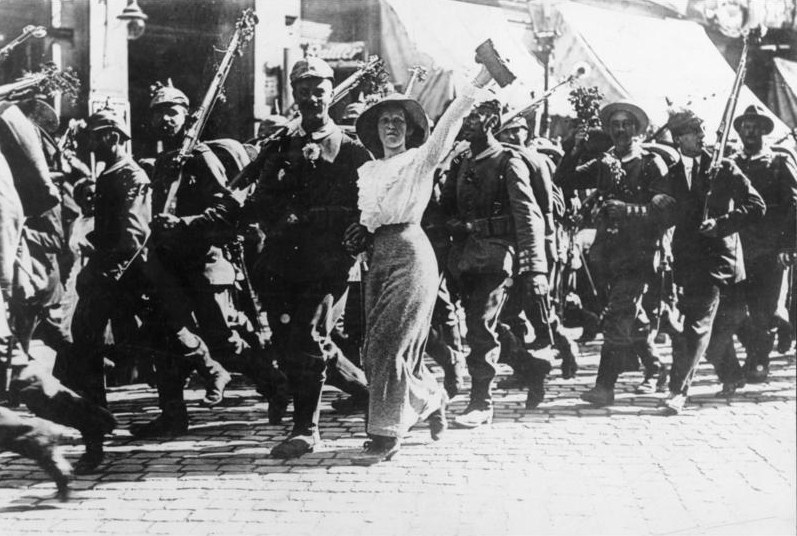
6 August. 1914 The artillery that marched across the Graben. Flowers, shouts of hurrah! and nazdar! The rigidly silent, astonished, attentive black face with black eyes.
I am more broken down than recovered. An empty vessel, still intact yet already in the dust among the broken fragments; or already in fragments yet still ranged among those that are intact. Full of lies, hate, and envy. Full of incompetence, stupidity, thickheadedness. Full of laziness, weakness, and helplessness. Thirty-one years old. I saw the two agriculturists in Ottla's picture. Young, fresh people possessed of some knowledge and strong enough to put it to use among people who in the nature of things resist their efforts somewhat. One of them leading beautiful horses; the other lies in the grass, the tip of his tongue playing between his lips in his otherwise unmoving and absolutely trustworthy face.
I discover in myself nothing but pettiness, indecision, envy, and hatred against those who are fighting and whom I passionately wish everything evil.
What will be my fate as a writer is very simple. My talent for portraying my dreamlike inner life has thrust all other matters into the background; my life has dwindled dreadfully, nor will it cease to dwindle. Nothing else will ever satisfy me. But the strength I can muster for that portrayal is not to be counted upon: perhaps it has already vanished forever, perhaps it will come back to me again, although the circumstances of my life don't favor its return.
Thus I waver, continually fly to the summit of the mountain, but then fall back in a moment. Others waver too, but in lower regions, with greater strength; if they are in danger of falling, they are caught up by the kinsman who walks beside them for that very purpose. But I waver on the heights; it is not death, alas, but the eternal torments of dying.
Patriotic parade. Speech by the mayor. Disappears, then reappears, and a shout in German: "Long live our beloved monarch, hurrah!" I stand there with my malignant look. These parades are one of the most disgusting accompaniments of the war. Originated by Jewish businessmen who are German one day, Czech the next; admit this to themselves, it is true, but were never permitted to shout it out as loudly as they do now. Naturally they carry many others along with them. It was well organized. It is supposed to be repeated every evening, twice tomorrow and Sunday.
Колыбельная (Lullaby) Инна Желанная Не такое нынче утро, Чтобы белое вплетать В косы русые по пояс. Не такой сегодня праздник, Чтобы руки в жемчуга, Чтобы бисером узоры. Не такой сегодня вечер,
Чтоб дымились пироги За весельем да застольем. А такая нынче ночка, Что до первых петухов Не увижу звезд на небе.
А такая нынче ночь, Что до самого утра Я повыплачу все слезы. А такая нынче ночь, Что я матушке пою Колыбельную немую.
“Let everything that's been planned come true. Let them believe. And let them have a laugh at their passions. Because what they call passion actually is not some emotional energy, but just the friction between their souls and the outside world. And most important, let them believe in themselves. Let them be helpless like children, because weakness is a great thing, and strength is nothing. When a man is just born, he is weak and flexible. When he dies, he is hard and insensitive. When a tree is growing, it's tender and pliant. But when it's dry and hard, it dies. Hardness and strength are death's companions. Pliancy and weakness are expressions of the freshness of being. Because what has hardened will never win.” Andrei Tarkosky